Information Management for Decommissioning
A few years ago we wrote about how legacy hardcopy data – wellfiles, seismic sections, basemaps, paper folios accumulated through decades of mergers, license rounds and farm-ins – had a quiet habit of becoming unfindable. At the time, the phrase “I wish I could put my hands on that report” was, for most operators, an inconvenience. Today, for operators preparing to decommission, it is a growing regulatory and financial headache.
Three things have changed since we last looked at this.
The work has changed
The North Sea, and basins like it, are firmly in a decommissioning phase. The NSTA’s Decommissioning Glidepath has formalised what most operators already knew: you cannot plan, cost or execute a credible decommissioning programme without trusted information on what is in the well, on the seabed and on the platform. The OEUK 2024 Decommissioning Report put hard numbers behind that pressure – cost per platform well is up by a quarter since 2021, and cost per exploration and appraisal well is up by more than half. Every gap in the record now carries a price tag, and every box of paper sitting in offsite storage is potentially a contingency line in someone’s AFE.
That has shifted attitudes. Hardcopy data is no longer a tidy-up job that can be picked up between projects. For decommissioning teams, it sits squarely on the critical path.
MiNDR’s core components of Intelligent Search, AI-assisted automatic tagging and regulatory compliance monitoring support operators with:
Effective decommissioning is built on a foundation of trusted information.
Flare’s industry-leading IM solution allows operators to quickly and cost effectively assess, optimise, and exploit all the information available to them to support good decommissioning decision making, and reliable decommissioning plan delivery across all phases of the Decommissioning Glidepath.


Increased Cost
Platform vs Exploration & Appraisal — 2021 to 2024
Decommissioning is expensive. Cost per platform well is up by a quarter since 2021. Cost per E&A well is up by over a half*.
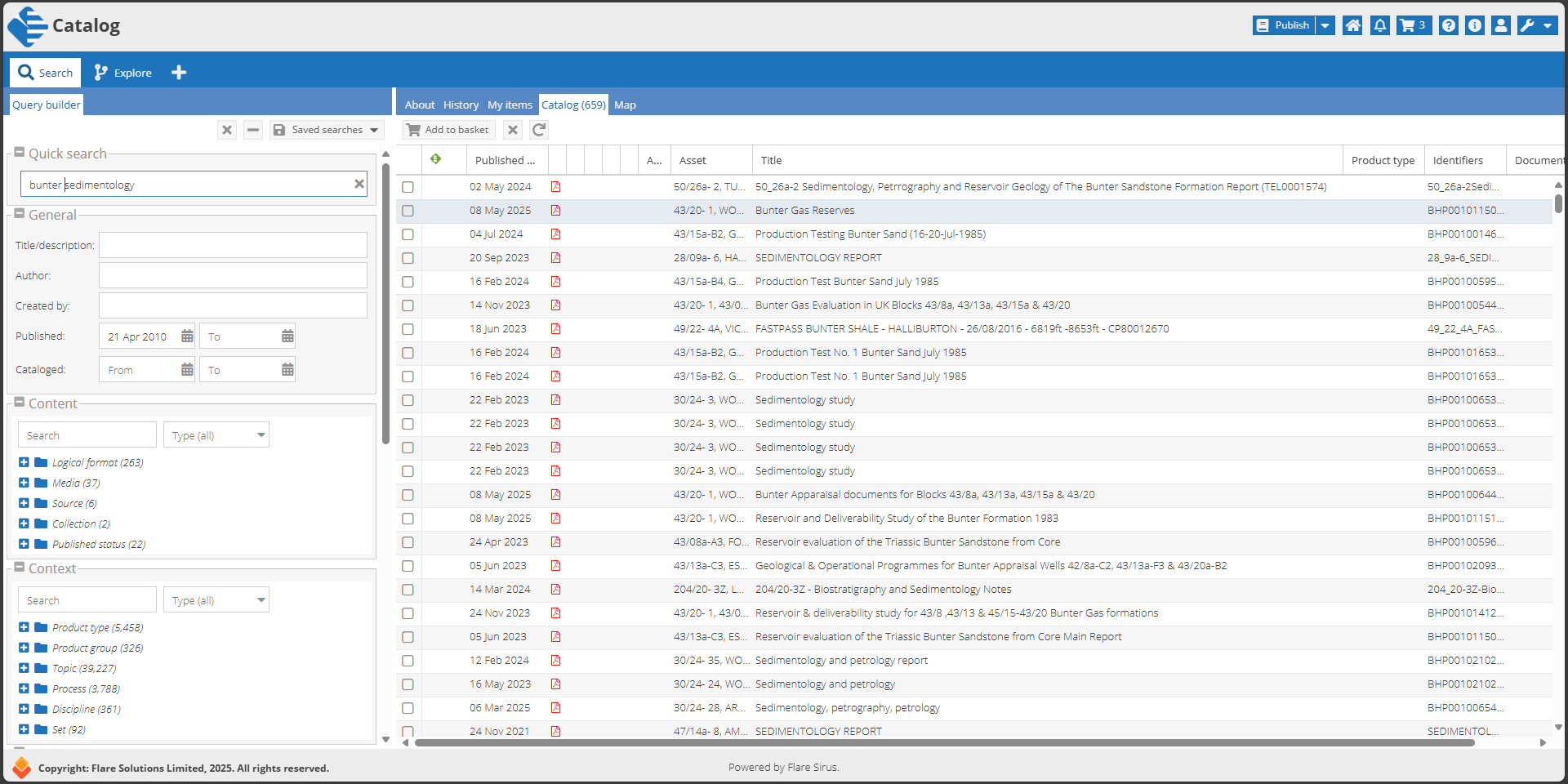
Powerful, intuitive search for the offshore energy industry
Finding the right document is still a challenge, even in today’s AI-powered energy industry. Getting a search engine to handle industry jargon is hard enough. When documents are scattered across SharePoint sites, file shares, and document management systems acquired over years of M&A activity, the challenge moves to the next level.
Flare’s solution to this problem isn’t simply to throw more technology at the problem. Large Language Models and GPTs have their place, but to understand that DDR is a Daily Drilling Report, and also a Daily Drilling Operations Report, and also a 6am Drilling Report, and 28 other aliases besides, and to work that out in a fraction of a second, requires a much more structured solution.
Our approach is to add a layer of context and understanding on top of our search technology, so that searching for DDR also finds DDOR, and that 204/20a-F1Y is understood to be a wellbore in the Schiehallion field – enabling more focussed, more relevant search results to be returned.
Flare’s Intelligent Search solution makes extensive use of the Flare Taxonomies to deal intelligently with oilfield terminology, while the Sirus Platform and its high performance graph database enables search results across millions of documents to be returned in seconds.
The Sirus Platform integrates with common industry document stores, like SharePoint, OpenText LiveLink and Documentum, as well as with file shares, so one search will find the document you’re looking for, no matter where it is.
With Flare’s Intelligent Search, there is no more doubt about whether a document can be found – either it’s in the search results, or it doesn’t exist.